The first time we had one, we were standing at a market in Ascoli Piceno. A man was selling them from a paper cone, freshly fried, golden brown and bone dry on the outside. We bit through and looked at each other. This wasn't a snack. This was something else entirely.
At home we always say: the olive ascolana is the Italian answer to the scotch egg. And whilst that's not entirely fair to either, everyone gets it straight away. A crispy outside, a warm filling within, irresistible with a glass of wine or a cold beer. The difference is that the Italians have taken two thousand years to perfect it.
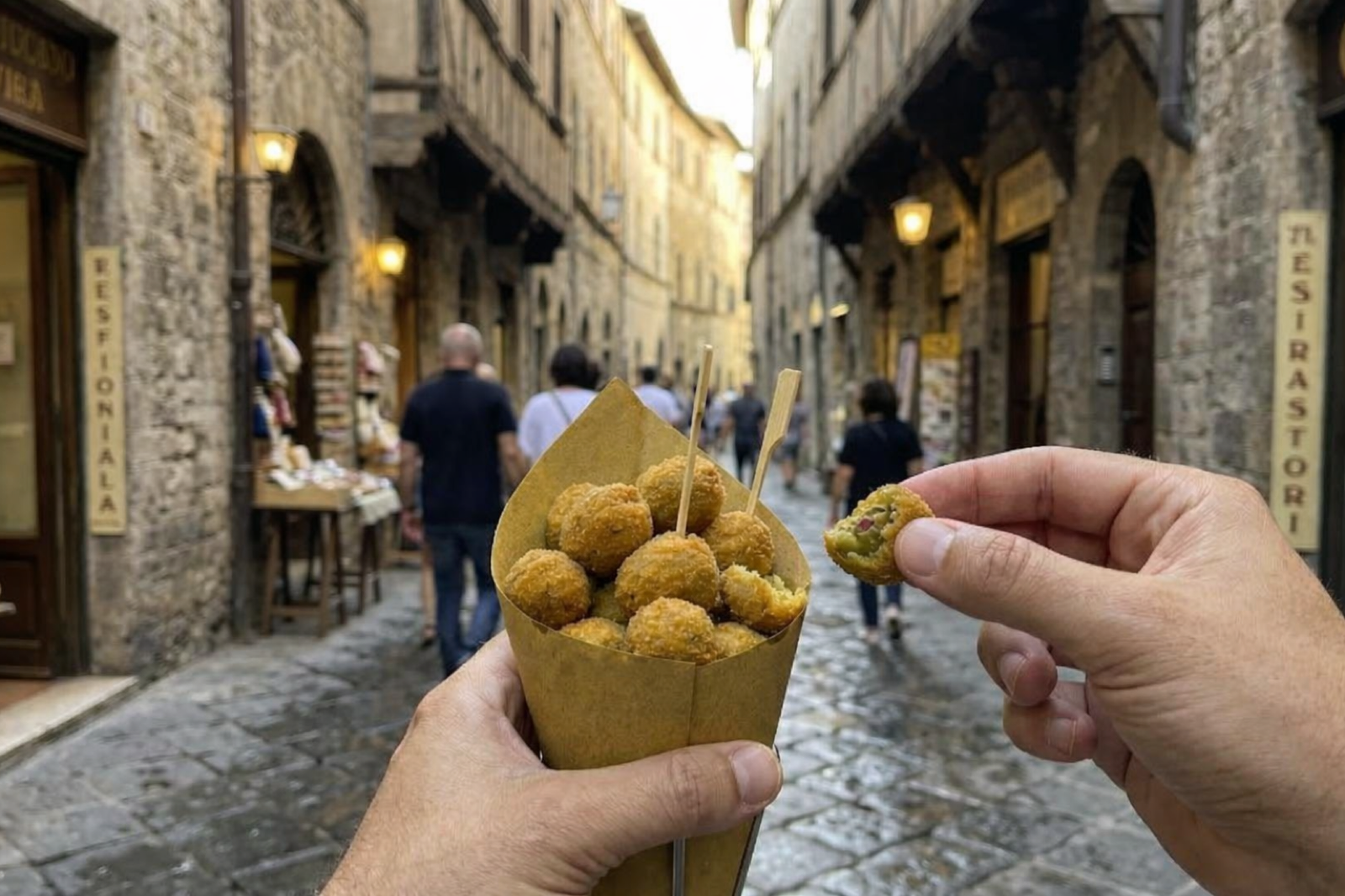
A dish of aristocracy and surplus
The olive that serves as the base is the Ascolana Tenera, an extraordinarily large, soft olive that grows exclusively on the chalky hills around Ascoli Piceno, in the southern part of Le Marche. Nowhere else in the world does this olive thrive. Garibaldi once tried to cultivate them on Sardinia. The trees didn't survive three years. The olive is loyal to its terroir.
What makes the Ascolana Tenera so special is the ratio of flesh to stone. Nearly 87 per cent of the weight is flesh, the stone is tiny. This makes it possible to pit the olive with a spiral cut, exactly as you'd peel an apple in one ribbon, and then fill it with a seasoned meat mixture.
The filling was born from aristocratic thrift. Around 1800 the noble families of Ascoli Piceno had more meat than they could use, delivered as tax by their tenants. The private cooks blended beef, pork and poultry, braised it slowly with soffritto and white wine, then ground it fine with Parmesan, nutmeg and lemon zest, and stuffed it into those large soft olives. Then through the flour, through the egg, through the breadcrumbs, and into the hot oil bath. The result was so good that two thousand years after the first Picene olives it remains the dish of the region.
"Rossini had them shipped to Paris. Puccini took them on tour. We now understand completely."
Healthier than a scotch egg?
We'll be honest: we like to tell ourselves this story. An olive is healthier than a ball of beef dripping, isn't it? Olive oil is good for the heart? Mediterranean diet and all that?
The truth is rather more nuanced. The olive itself is indeed mild in flavour, full of good fats and a classic part of the Mediterranean diet. The filling contains meat, egg and cheese, and the whole thing is deep-fried in a thick double coating. Let's just say it won't do you any harm. But frankly that's not the point. The point is that you're sitting on a terrace in Le Marche, the sun has just dipped behind the hills, there's a glass of Verdicchio on the table, and someone puts down a paper cone of olive ascolane. At that moment you're really not thinking about calories.
Two millennia and a DOP certification
That this dish has survived so long is no coincidence. The Ascolana Tenera has carried the DOP certification since 2005, an Italian quality label protected by the European Union. Only olives from 89 specific municipalities in Le Marche and a small part of Abruzzo may bear the name. Fewer than 600 tonnes per year are produced, whilst demand is double that. Whoever eats real olive ascolane is eating something rare.
The recipe is below. We've compiled it from the most authentic sources in Ascoli Piceno, including the required spiral cut, the braised then ground meat filling and the double coating that makes the difference between an ordinary fried olive and an olive ascolana you'll never forget.
The recipe
Olive all'ascolana
Traditional recipe for 4 people, approximately 40 to 50 olives
The olives
- Oliva Tenera Ascolana DOP in pekel400 g
- Wilde venkel (for the soaking water)a few sprigs
The filling
- Lean beef or veal150 g
- Lean pork75 g
- Chicken breast or turkey25 g
- Onion, carrot, celery (soffritto)65g total
- Dry white wine60 ml
- Parmigiano Reggiano, finely grated30 g
- Egg yolk1
- Nutmeg½ tl
- Lemon zest½ lemon
- Extra virgin olive oil2 el
- Salt and pepperto taste
The coating
- Tipo 00 bloem100 g
- Eggs (plus the reserved egg white)2
- Fine breadcrumbs200 g
- Groundnut oil or olive oil (for frying)ruim